How will archaeologists imagine our world hundreds of years from now?

This article is also available in: العربية · Deutsch
When I was young, some time before 2006, I saw a picture in a newspaper – a Syrian one, I think. I've forgotten the paper's name, but the picture stayed with me. It imagined what archaeologists might find hundreds of years from now, when the things we carry in our pockets today have become artefacts to be studied and shown in museums. I tried to recreate the picture with the help of ChatGPT, as far as my memory allowed.

As far as I remember, the caption underneath said something like this:
Archaeologists have found a well-preserved fossil containing a device once used for primitive voice communication, a number of metal coins, and a third object whose purpose researchers are still trying to work out.
The third object was a key ring. It amused me that the researchers understood what the phone was for but were baffled by a toothed piece of metal. Today, looking at the picture again, I find their confusion reasonable. If I found a key in an age where I'd never seen a lock like ours, what would tell me those little teeth were made to open a door?
When yesterday becomes a museum
It doesn't take centuries for our things to turn into puzzles. Two decades are enough.
The floppy disk is a good example. For years it was the natural way to move a file from one computer to another, with 1.44 megabytes that would barely hold a single phone photo today. Then it quietly disappeared, leaving only the “save” icon in our programs. And here's the irony: a whole generation clicks that icon every day without knowing it's a picture of a real object.
The list is long: the cassette tape, the screech of the modem dialling into the internet, top-up cards we scratched with a coin, the printed phone book, the landline. Things that lived with us for years and then left daily life without saying goodbye.
How earlier generations imagined our time
Today we live inside the “future” our parents and grandparents tried to draw. Comparing what they imagined with what actually happened is the most honest test of humanity's ability to predict – and the most honest mirror of its limits.
The “In the Year 2000” cards (France, 1899)
Shortly before the 1900 World's Fair in Paris, a French toy company commissioned the illustrator Jean-Marc Côté and other artists to draw cards imagining life a hundred years later, to be tucked into cigarette and cigar boxes. They drew firefighters with wings, flying taxis, and a device resembling a video call. The cards vanished for decades until Isaac Asimov came across a set and published them in a book in 1986 (The Public Domain Review, Open Culture).
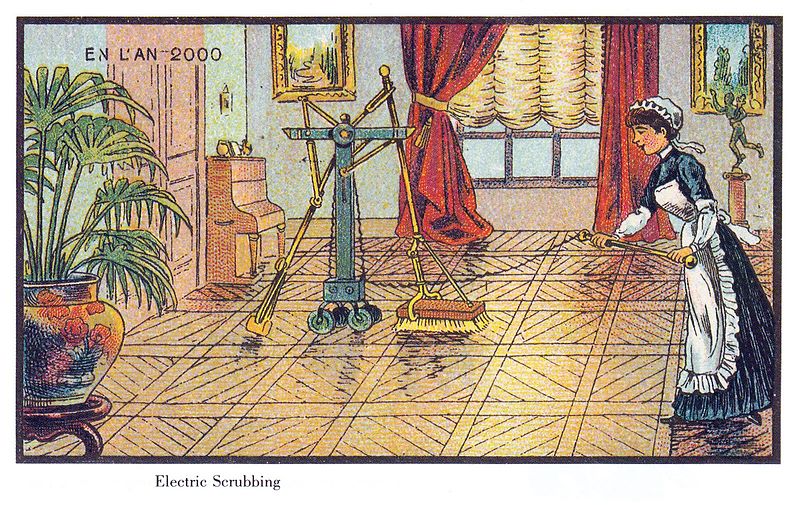


What stands out isn't what they got right or wrong, but how they went about it: every invention on the cards is a machine of gears, belts and levers. They imagined the future with the tools of their own time.
Watkins and the “Ladies' Home Journal” (1900)
In December 1900, the American engineer John Elfreth Watkins published an article titled “What May Happen in the Next Hundred Years”, collecting predictions he had gathered from scientists at major institutions. Some were astonishingly accurate: photographs telegraphed from any distance, a small wireless telephone carried in the pocket, and tanks (BBC News via Wikipedia). Others were comically wrong: the letters C, X and Q would be dropped from the English alphabet as unnecessary, and peas would grow as large as beets. He predicted Americans would live to fifty instead of thirty-five – reality was far more generous: life expectancy there reached about 77 years by 2000 (Saturday Evening Post).
Keynes and the fifteen-hour week (1930)
In the depths of the Great Depression, the British economist John Maynard Keynes wrote the essay “Economic Possibilities for our Grandchildren”. He predicted that living standards would multiply several times over within a century, and that by 2030 people would need to work only about fifteen hours a week – so that humanity's biggest problem would become: what do we do with all this time? (Quote Investigator).
The wealth did come; the fifteen hours did not. We turned productivity into more things rather than more time. The economic historian Nicholas Crafts argues that Keynes wasn't entirely wrong: lifetime leisure has grown a great deal thanks to longer retirements and longer education, but the fifteen-hour week won't happen (CEPR). The philosophical lesson: technology tells you what's possible, but not what people will choose.
Three lessons from the graveyard of predictions
- We overestimate the short term and underestimate the long term. That's the essence of what's known as “Amara's law”, after the American researcher Roy Amara. The flying car didn't arrive on time, but the phone in your pocket is greater than anything any of them imagined.
- We predict machines and forget people. The big mistakes in predictions weren't technical but social: who would work, for how many hours, and who would sit at the scientists' table.
- The hardest thing to predict is what makes the question itself disappear. People imagined faster fax machines and nicer phone boxes, and almost nobody imagined a network that would make the fax and the phone box meaningless.
A whole day in 2126
127 years ago, Jean-Marc Côté and his colleagues sat down to draw France in the year 2000: firefighters with wings, and pupils having books ground up for them in a machine. We laughed at them, but they got the spirit of things right and the form wrong. I'll do the same, with the same boldness: I'll fall asleep tonight and wake up in 2126, and draw my day there hour by hour. I'll let my imagination run, but every flight of fancy here has its roots in a real lab today, which I'll name under each scene. And I know my grandchildren will laugh at me the way we laughed at Côté. That's part of the fun.
And so as not to simply draw enlarged versions of today's machines, as Côté did, I'll start with one question: which things seem “normal” to us today but are really temporary fixes for problems we haven't solved yet? Passwords, dozens of which we memorise and then write on a yellow sticky note. Chargers and cables – only our generation knows what it means to dig through a drawer for the “right” one. The steering wheel we hold in our hands for hours every day. And the keyboard, whose letter layout was designed for nineteenth-century typewriters. These are the first things I expect to find in the museum. But I also expect that in 2126 I won't need a user manual so much as an interpreter of customs: how people talk to machines, what counts as polite and what counts as rude, and the jokes I won't get because they refer to something I missed. If words like “trend”, “story” and “live” entered everyday Arabic in less than twenty years, what will a hundred years do to a language?
06:45 — A message without fingers
I reach for my phone and find only a slim ceramic ring and a tiny earpiece, the size of a lentil, stuck behind my ear like a mole. I think of someone: “Good morning, I'm up.” A second later the ring vibrates: “Delivered.” I didn't type and I didn't speak. The earpiece picks up my brain signals as I phrase the sentence in my head – not all my thoughts, only what I deliberately “say” to myself with the intention of sending it. I try thinking something annoying, and nothing happens. I breathe a sigh of relief: the machine knows the difference between what I want to say and what I'm merely thinking. Or so I hope.
The screen appears in two contact lenses I can't even feel: transparent windows floating in the air that nobody else can see. Later, people in the street look as if they're gazing into space with a smile, when in fact they're reading.
And no passwords. I ask the house for the password to my old account, and it falls silent for a moment as if it didn't understand the question, then kindly explains that accounts recognise me by my voice, my gait and my heart rhythm all together. And not a single charger in the whole house; things charge themselves from light, movement and heat: “No more fighting with the rest of the family over the charger, the cable and the socket”. Out of habit I open the drawer and find not one tangled cable. I feel a strange emptiness, like someone who has lost an old enemy.
The science behind it: Paralysed people today type with their thoughts through chips implanted in the brain, and recent research experiments have begun decoding the sentences a person formulates from brain signals without surgery. Contact lenses that display information exist as prototypes.

07:00 — A shirt in twenty colours
This is the one thing women won't like: there are only three pieces in the wardrobe. I run my finger along the shirt's sleeve and it changes from white to navy, then patterns of Damascene brocade spread across it in glittering gold thread. A third swipe and it's striped. The same fabric can be twenty shirts. The jacket is lighter than a sheet of paper; its fibres puff up when it gets cold and contract when it's warm, so there are no heavy coats in this world.
Stranger still, the shirt charges the ring as I walk: every movement of my arms generates a little electricity. And when something tears, the rip closes up by itself within a few hours, like skin.
Later in the street I see that fashion has become a bold mix: abayas with glowing sleeves, sirwal trousers in fabric that changes colour with your mood, and kimonos printed with Umayyad mosaic patterns. Once clothes could do anything, people chose to wear their cultures.
The science behind it: Fabrics that change colour electrically, textiles that generate electricity from movement, self-healing polymers, and leathers and fabrics grown from fungi all exist today in labs or in experimental products.

07:20 — Breakfast from the printer
In the kitchen there's a machine the size of a small oven that prints my breakfast layer by layer: a cheese pastry with the perfect texture, the cheese itself made by fermentation from yeast rather than from a cow. Meat, if I want it, is grown from cells at the neighbourhood plant; cows haven't been slaughtered for a long time and now live on farms the way cats live in homes. The vegetables come from the vertical farm in the building: a whole floor of tomatoes and mint under purple light. Only the bread still arrives hot from the neighbourhood bakery, made by a real baker's hand. Some things found no reason to change.
The science behind it: Cultivated meat grown from cells received its first commercial approval in Singapore in 2020, proteins made by precision fermentation are sold today, and 3D food printing and vertical farms are established technologies.

08:00 — A city that grows
I go down to the street and hear the birds before I see anything. No engines, no horns. The car park under the building has become a fig orchard. The buildings themselves look as if they grew out of the ground: walls of straw-coloured fungal bricks, with dormant bacteria in their cracks that wake up when the wall cracks and secrete limestone that seals the crack by itself. Buildings here aren't repaired; they heal.
The street lamps have disappeared. Last night I noticed the street was lit by a soft green glow, and now I understand why: the trees along the pavement glow in the dark. They were given genes from luminous fungi.
The science behind it: ++++A glowing petunia engineered with genes from a bioluminescent fungus is sold in the United States today, self-healing bacterial concrete was developed at Delft University of Technology in the Netherlands, and bricks made from fungi are being tested in architectural projects.

08:30 — A driving licence, for fun only
No vehicle has a steering wheel. Public vehicles are shaped like a large almond, with panoramic glass and a small wooden sitting area inside; you summon one with a gesture of the ring and it arrives within a minute. When I tell the other passengers I used to drive my own car every day, they look at me with the same astonishment we'd give someone who said he used to ride to work on a horse. Driving here is a hobby, like horse riding for us: it has its own clubs and closed tracks, and its fans wear leather gloves and old-fashioned helmets.
For longer distances, small eight-rotor craft take off from the rooftops, like dragonflies, so quiet that I only noticed one when its shadow passed over me. Côté drew flying taxis in 1899. They were 227 years late, but they arrived.
The science behind it: Driverless taxis operate in several cities today, and many companies are testing electric vertical take-off aircraft to carry passengers within cities.

09:30 — Working by talking
I arrive at what used to be called an office and find a studio that is workshop, café and library at once. I nervously ask about my job as a programmer, and a young man takes me to a large table. Nobody writes code here; I describe what I want in words, and a working application takes shape in front of me within minutes. I adjust and try again, and feel I've gone from the cook who chops the onions to the one who decides on the dish. The skill here is no longer in the writing, but in knowing what's worth building, for whom, and why.
In a corner of the studio, behind glass: an ordinary keyboard from my time. A school class on a trip stands in front of it while the guide explains that people used to press little squares in order, letter by letter, to write a message. One child laughs and asks: “And why are the letters all mixed up like that?” Nobody knows the answer. I do, but I'm too embarrassed to say it's because of a nineteenth-century typewriter.
The science behind it: AI models today write complete programs from natural language descriptions, and mid-air hand tracking already exists in mixed reality headsets.

13:00 — Shawarma and the coins of the Sleepers of the Cave
I walk into a market bursting with colour. Yes, shawarma survived, thank God. I take a sandwich and reach into my pocket out of habit, pulling out the last thing I have left from my time: a few metal coins. The vendor turns them over with the amazement of someone who has found treasure and calls everyone in the market over to look. I feel like the sleeper with the “silver coins” in the story of the People of the Cave, carrying money from another age into a city that no longer recognises it. Payment here happens automatically when you leave, but the vendor refuses to take money for the sandwich and instead asks for one of my coins for his son, who collects “twenty-first-century antiques”.

15:00 — Syria, closer than ever
I tell the ring: “I want to talk to my family.” Seconds later the living room fills with my brother's grandchildren, life-size, sitting on the sofa, and the walls around us have become the courtyard of their house. My brother's daughter reaches out her hand to greet me; hesitantly I reach out mine, and I feel it. Not completely, but enough: a hint of warmth and the press of fingers. The thin glove the house handed me transmits touch across continents.
They ask when I'll visit, and I ask how long the journey takes. The ring tells me the vacuum tube train leaves Germany and arrives in Damascus in about half an hour – less than the length of a film. A journey that took some of us days of sea, borders and waiting.
The science behind it: Gloves and haptic devices that transmit pressure and warmth over a distance are in development, and the idea of a train in a vacuum tube has been tested on real prototypes, though it remains far from commercial use.

19:30 — Customs
The neighbours invite me to dinner on the roof. Every family brings a dish: kibbeh made from cultivated meat that tastes no different from the meat I knew, sushi, stuffed vegetables, and an Ethiopian dish whose name I don't know. I say “yaatik al-afieh” – “God give you strength” – to the robot carrying the plates, and everyone laughs: nobody has thanked machines like that for seventy years, just as nobody in my time thanks the fridge. I speak a little loudly, and my glasses gently whisper that a loud voice at the table is now considered rude, because everyone hears perfectly well.
Then they laugh at a joke I don't get, because it refers to something that happened fifty years ago. They use new Arabic words I don't know, and words I know with different meanings. And when I enthusiastically call the dinner “trendy”, they exchange glances the way we used to when my grandfather said something was “all the rage”. Then coffee is poured from a copper dallah, I smell the cardamom, and I feel at home.

21:30 — The sky
We lie on the roof looking at the sky. The moon is full, and small points of light can be seen on it: research stations and a small town where a few thousand people live. The moon colony Asimov promised us for 2014 has arrived, more than a century late.
And in the distance, above the equator, something unbelievable: a very thin ribbon rising from the ocean into space and never ending, with small cabins climbing it like beads on a string. A space elevator. No rockets burning thousands of tonnes of fuel, but a lift you ride the way you ride the lift in your building, reaching Earth orbit after a few days. Nobody around me even looks up; to them it's as ordinary as a plane taking off.
The science behind it: This is my wildest flight of fancy. The idea of the space elevator was put forward by the Russian scientist Tsiolkovsky in the late nineteenth century, and space agencies study it seriously, but it requires a material stronger than anything we can produce in large quantities today, such as carbon nanotubes. As for moon bases, programmes to return to the moon are already under way.
22:30 — The key
I return to my flat and, out of habit, look for my key at the door. I find it in my pocket, the last thing I have left from 2026. The door has no lock and no keyhole; it recognises me and opens by itself. I smile and hang the key on a nail in the wall, the way people hang an old sword or a photo of a grandfather.
Before I sleep, the house asks whether I'd like to choose the subject of tonight's dream; there are gentle sounds and scents that help the brain dream about what it likes. Then I look at the key on the wall and think: all the devices of my time are dead, and this alone still works. It needs no charging, no updates and no password. I fall asleep excited, because tomorrow will bring something I don't know.
The science behind it: Research into “dream incubation” at labs such as MIT uses sounds and suggestions at the moment of falling asleep to influence what a dream is about.

How we imagine the future today
If a writer came along in a hundred years and did to us what we've done to Watkins and Asimov, what would he find in our archive? He'd find two pictures competing for the future: an optimistic one driven by technology, and a cautious one driven by numbers.
The optimists' picture: the singularity
The best-known representative of the first picture is the American inventor and computer scientist Ray Kurzweil. In his book “The Singularity Is Near” (2005), he predicted that computers would reach human-level intelligence by 2029 and that humans would merge with machines around 2045, a moment he called the “singularity”. In his next book, “The Singularity Is Nearer” (2024), he stuck to both dates and said humans would expand their intelligence a millionfold by 2045 (The Guardian via Yahoo). Interestingly, the 2029 date that seemed crazy in 1999 is one Kurzweil himself now calls “conservative”, because other experts talk of two or three years (BBC Science Focus).
This is far from a consensus view; many scientists believe that what we have today are amazing tools, not minds, and that the “singularity” is closer to faith than to science.
The numbers' picture: an older world
On the other side are predictions that are less glamorous but more solid, because they rely on people who have already been born. The United Nations' “World Population Prospects 2024” report expects the world's population to peak in the mid-2080s at around 10.3 billion and then decline to about 10.2 billion by 2100. It expects people aged 65 and over to outnumber those under 18 by the late 2070s. Germany, China, Japan and Russia have already passed their population peak (United Nations).
This picture talks neither of robots nor of space colonies, but it may change the shape of life more than any device: cities designed for older people, schools closing for lack of children, and economies searching for workers.
When we look at the cards from 1899, we laugh because everything in them flies. Let's admit that our own imaginings have their “wings” too: artificial intelligence in everything, just as the steam engine and the airship were in everything for Côté. We project the obsession of our present onto the future, as every generation before us did.
And it isn't only about technology. The future in our collective imagination is split between a shining utopia and a bleak dystopia, and series such as “Black Mirror” describe not so much the future as our anxiety about the present: about privacy, screens, losing control. Every prediction is partly a confession of what is worrying its author right now.
If we apply the lessons of the graveyard of predictions to ourselves, we're probably overestimating what will happen in ten years and underestimating what will happen in a hundred. And the biggest change of the coming century will most likely be something we don't have a name for yet, just as Watkins had no name for the internet.
A visitor from 2226
Now let's turn the question around: what if a man from the year 2226 came to visit us?
The best way to imagine his reaction isn't to imagine the technology of 2226 – that's impossible – but to look back the same distance. If someone from 1820 visited us today, his problem wouldn't be that he doesn't understand the phone, but that he lacks the very concepts the phone is built on: electricity, the wave, digital information. Before any explanation, he'd need a whole century of ideas.
He won't see us as wizards, but as craftsmen
The science fiction writer Arthur C. Clarke said that any sufficiently advanced technology is indistinguishable from magic. That's true when we look forward. But the visitor from 2226 looks back, and in his eyes our technology won't be magic but handicraft: noisy, hot, wasteful, the way the steam locomotive looks to us today. He'll look at our phones the way we look at a mechanical pocket watch in a museum: beautiful and finely made, and a little touching in its primitiveness.
What will seem strange to him?
- We burn the remains of creatures that died millions of years ago inside engines to get around, and release their smoke into the streets.
- We work forty hours a week even though Keynes promised us fifteen.
- We carry devices that know more about us than our mothers do, then tap “I agree to the terms and conditions” without reading a line.
- We call our data stores “the cloud” as if they were something light in the sky, when they're huge buildings using as much electricity as entire cities.
- We type with our fingers on a letter layout designed for a typewriter.
- And, despite all this, we carry a toothed piece of metal in our pockets to open the door.
The things we boast about today, the latest phone and the fastest processor, will look to him like a man showing off his paraffin lamp.
The court of the future
We judge the past constantly: How could they accept slavery? How could they keep women from education? Historians call this tendency “presentism”, judging the past by the values of the present. The visitor from 2226 will fall into the same trap and judge us. The uncomfortable philosophical question: what do we do today, and consider normal, that will seem unbelievably cruel to our grandchildren? Perhaps the way we treat women, perhaps the way animals are raised on factory farms, perhaps the way we handle people's data, perhaps something we haven't noticed yet. Every generation has moral blind spots, and only those who come after can see them.
He'll stumble over the dialect, not Standard Arabic
Dialects change quickly, and the dialect of 2226 may seem as strange to us as the colloquial speech of the nineteenth century does today. But Arabic speakers are lucky here: Standard Arabic, anchored in texts that have stayed fixed for fourteen centuries, will most likely remain a shared bridge. An English visitor from 2226 might need an interpreter more than an Arab one would.
And the heaviest thing he carries
Heavier than all of this is that he'll know how stories we're living through now will end, though we don't know their endings: which invention will change the world and which will be forgotten, which argument will seem trivial ten years later. And that raises a question as old as philosophy: would we live differently if we knew the ending?
A world with fewer, older people
If the United Nations' numbers are right, the world of 2250 will live a century and a half after the population peak. I imagine a less crowded world, where a child is a rare event the whole neighbourhood celebrates, and where cities are built around those who walk slowly rather than those who run. And I imagine that “young people” will become the most precious resource on Earth, more precious than oil in our time.
AI will disappear – in the sense that it will succeed
Nobody today says “I used electricity this morning.” Electricity succeeded so completely that it became invisible. I imagine artificial intelligence will meet the same fate: nobody will talk about it, because it will be in everything. And the very phrase “artificial intelligence” will sound old-fashioned and funny to our grandchildren, the way “horseless carriage”, as people once called the car, sounds to us.
Keynes's question will return – and this time it will be serious
If the energy problem is solved and much of the work is done by machines, we'll come back to the question Keynes asked in 1930 and that we ran away from: what does a person do when they no longer have to work to live? I think the biggest industry in 2250 won't be making things, but making meaning: education, art, sport, religion and care. What's hard to automate is precisely what makes life worth living.
Our era may be the “digital dark age”
Here an irony occurs to me that touches the newspaper picture directly. Sumerian clay tablets can still be read after five thousand years. Our files, meanwhile, are stored on media, in formats and software that become obsolete every few years. Vint Cerf, one of the fathers of the internet, warned that our century could become a “digital dark age”, because whatever isn't constantly moved from one format to the next gets lost. Historians in 2250 may know more about Damascus in the twelfth century than about Damascus in 2020, because the former was written on paper.
In the end
There's an idea known as the “Lindy effect”: the longer a technology or an idea has survived, the more likely it is to survive longer still. The spoon, the chair and the key have passed the test of centuries; the smartphone is still in its first year of it. That's why I think the real archaeologists of the future will be more puzzled by our smartphone, with its dead battery and unreadable memory, than by a key – they need only find a single lock to understand it. The key explains itself through its shape. The phone needs an entire world to be understood.
And perhaps that's the whole lesson. Every generation thinks its tools are the end of the story. Then someone comes along, finds those tools in the dirt, puts them behind glass, and writes a little label underneath: “An object whose purpose researchers are still trying to work out”.
Sources
Predictions of the past
- The “In the Year 2000” cards: The Public Domain Review, Open Culture
- Watkins 1900: Wikipedia, citing the BBC, Saturday Evening Post
- Keynes 1930: Quote Investigator, Nicholas Crafts, CEPR
- Asimov 1964: Scientific American, Smithsonian
- Back to the Future Part II: Nextgov, WTOP
Predictions of today
- Kurzweil: The Guardian interview via Yahoo, BBC Science Focus
- World Population Prospects 2024: United Nations